Day: July 17, 2022

  • Create To-do Lists – Improve Your Productivity

    Create To-do Lists – Improve Your Productivity

    Create To-do Lists So That You Can Improve Your Productivity

    To-do lists are widely used productivity aids. And although most individuals strive to be productive, it takes a lot of effort to be productive. You must be dedicated, driven, and well-organized. A to-do list is a list of tasks that must be completed within a certain time range. It assists you in organizing and reminding you of your planned duties.

    A to-do list may be used to organize any element of your life. Are you unclear about how much a to-do list may help you be more productive? This essay will assist you in making your decision.

    Benefits Of Keeping A To-do List

    A busy agenda with no organization, according to time management expert and author David Allen, leads to trouble. You need a method, and handwritten notes on your palms won’t do. You can profit from a to-do list in the following ways.

    Measure your progress: Using a to-do list allows you to keep track of your progress throughout the day or with a specific project. You will feel driven as you complete the items on your list.

    Reduces forgetfulness: If you are prone to forgetfulness, a to-do list may be incredibly useful. If you have everything written down on a list, you are less likely to miss an appointment or forget to call.

    Break down chores: A to-do list is an excellent tool for breaking down large activities into smaller actions. This is excellent for converting abstract objectives into actionable tasks.

    Reduces anxiety: If you are feeling concerned about the quantity of work you have to complete, a to-do list might help you relax. A to-do list may help you organize your work into a straightforward step-by-step procedure rather than a mess of ideas.

    Keeps you focused: Our lives may become rather stressful as a result of unplanned circumstances, and individuals often lose sight of their initial intentions for the day. A to-do list allows you to return to the drawing board at any time of day and refocus your attention.

    How To Create A To-Do List That Works

    Stressed Online

    Clearly state your tasks.

    You should avoid not describing your task items clearly enough. If your to-do list lacks specific things, you may struggle to prioritize them or recall exactly what you wanted to complete. In either case, the chores are not completed.

    If you wish to email your employer, it is not enough to just type “boss” on your list. You should also provide work specifics.

    Break down tasks

    Avoid putting iceberg activities – jobs that seem easy but take substantial preparation or effort – on your list without first breaking them down. The same is true for huge objectives. There’s a danger you’ll become trapped or fatigued attempting to do the iceberg duties and end up doing nothing else.

    Instead of putting something like “create a new book” on your to-do list, why not add something like “outline the first chapter of my novel”?

    Plan with reality in mind

    Keep all parts of your life in consideration when you build your to-do list. If you have a family or a side enterprise, any of these things may interfere with finishing your list. So, don’t overburden your to-do list with things that you won’t be able to do while still satisfying your other responsibilities.

    Batch tasks

    Because they share comparable tools and resources, you may do certain activities on your to-do list sequentially or concurrently. It makes sense to write them together. As you can simply go from one to the other, you may optimize your time and energy.

    For example, if you need to contact many persons, organize the tasks on your list around the same time period. That way, you may send all of your emails for the day while you’re at your computer. It is much simpler than sending the first email and then visiting suppliers before sending the following email.

    Make it interesting

    A to-do list might seem like chains that confine you to energy-sucking tasks all day for many individuals. According to Art Markman, we feel this way because our to-do lists are monotonous and devoid of inspiration. So, while you’re writing down your to-do list, include a line to remind yourself of the importance of finishing each activity.

    You should intersperse pleasant activities with important responsibilities. You may then take a well-deserved rest without feeling guilty. Also, if your pleasurable activity is scheduled like the rest of your chores, you are less likely to get carried away.

    Order your tasks

    Being productiveYou may arrange your to-do list in a variety of ways. Items may be arranged from most difficult to easiest and vice versa. You may also organize the things on your to-do list in order of priority or urgency.

    There’s a risk you won’t be able to do everything on your to-do list. As a result, we propose that you prioritize the most critical chores. This way, you may attend to them first and prevent complications caused by leaving critical tasks undone.

    Keep it simple

    Productivity is not doing a lot of things at once; it is doing things effectively. So, resist the urge to fill your to-do list with activities or complications.

    Conclusion

    Always put your to-do list in plain sight or someplace that requires little effort to access. It is much easier to keep track of and hold oneself responsible in this manner.

    You may not complete every task on your to-do list within the time allotted. Many folks do not. However, you will discover that you accomplished more with a to-do list than without one.


    The post Create To-do Lists – Improve Your Productivity appeared first on https://gqcentral.co.uk

  • The Connection Between Earwax And Food

    The Connection Between Earwax And Food

    The connection between earwax and food

    The connection between earwax and food: Did you know that some foods might contribute to earwax production?

    Gluten is a protein found primarily in wheat, barley, and rye products. Excessive gluten consumption can result in increased earwax production.

    Milk sugar (lactose) in dairy products might cause increased earwax production, especially if you are lactose sensitive.

    Ear wax production can be exacerbated by a diet high in sodium or salt. High blood pressure can also be caused by salt or sodium, which reduces blood flow to the ears and increases earwax production.

    Caffeine is generally found in coffee, tea, and energy drinks and is high on the list of foods that cause greater earwax production.

    Sugar contains glucose, which can cause an increase in earwax in the ear canal. Diabetes patients also have a 30% increased risk of hearing issues.

    Soy is a legume frequently used as a meat or dairy alternative. Too much soy or soy products (tofu, soy nuts, soy sauce) can increase earwax production.

    Never put anything in your ears to remove earwax. Inserting small sharp items into your ears is harmful and can aggravate accumulation problems by pushing the wax deeper into your ear canal.

    the connection between earwax and food

    Ear Wax Removal Bury st Edmunds.

    What your earwax can tell you about your health

    Did you know that your earwax might reveal much about your overall health? Here are some earwax facts you may not be aware of!

    Earwax is typically yellow/orange or brown. If your earwax appears yellow/green, this could indicate infection. Therefore consult your doctor.

    Scaly earwax may indicate dermatitis, which is treatable with over-the-counter medicines.

    Earwax should not have an odour. If it happens, it could be a sign of an infection or an eardrum tear. Consult your doctor for guidance.

    Earwax that is watery is frequent after a sweaty workout; if it comes out of your ears at other times, it could be due to ear infections caused by swimming or other water-related activities. The best course of action is to make an appointment with your physician.

    If you can feel earwax, it could signify that your ear canal is filled with extra wax and has to be cleaned out by a professional.

    An odd itch in your ear is nothing to be concerned about, but if the irritation persists, you may have an ear infection. Something as easy as a new shampoo or soap could be the source of the itch.

    We produce more dark earwax as we get older. Consult your doctor if you are concerned because your earwax is generally lighter.

    Eight lifestyle practises that may influence earwax production.

    Did you know that some components of your lifestyle can contribute to earwax? Genetic factors may also be involved. Avoiding the creation of earwax can be prevented by being aware of the following warning signs.

    Alcohol causes the ear to absorb more fluid and increase blood flow, leading to ear infections, tinnitus, and earwax overproduction.

    Tobacco use – the harmful compounds in cigarette smoke (formaldehyde, benzene, arsenic, vinyl chloride, ammonia, and hydrogen cyanide) can impair hearing and harm your hair cells.

    Smoking also causes middle ear pressure to build up, leading to increased earwax discharge, hearing loss, and infection.

    Headphones/Earplugs: If you routinely wear headphones, earwax can accumulate over time since they inhibit regular evacuation of earwax from the ear canals, resulting in obstruction.

    Cleaning: Using cotton swabs, ear candles, or other utensils can prevent earwax from leaving the ear naturally. Earwax can sometimes get into the ear canal and become trapped, pressing against the eardrum.

    Environment: If you live or work in a dusty environment, your earwax may hold more dirt particles, leading to higher production.

    Family history – genetics can also influence ear health. If your parents had earwax issues, chances are you do as well!

    Anatomy – narrow, tiny, or hairy ear canals can cause earwax buildup and blockage since it is more difficult for the wax to come out naturally.

    Age – Our ears’ self-cleaning system becomes less effective as we age. Earwax begins to dry out, increasing the likelihood of it becoming compacted and trapped in the ear canal.

    Earwax causes, symptoms, and treatment

    Ears require just as much attention as any other feature of the body. Trevor Chapman, the audiologist at angle-EAR Hearing in Great Shelford, discusses everything there is to know about earwax and ear care.

    What exactly is earwax?

    Earwax is a naturally occurring yellowish-brown material found in the ear. Earwax does not cause issues in many people. However, earwax buildup can cause a variety of symptoms.

    What causes the body to manufacture earwax?

    Although the exact function of earwax is unknown, it is assumed to contribute to ear cleanliness, hygiene, and overall health by trapping debris and lubricating the ear canal.

    What causes earwax to settle?

    The amount of earwax secreted varies widely between individuals; one ear may produce more earwax than the other. For certain people, earwax can build up in the ear canal for a variety of reasons, including:

    The lining of the ear canal is no longer shed correctly, resulting in earwax buildup.

    Chronic ear infections, hereditary crookedness, or narrowing deep in the ear canal

    Using cotton swabs or wearing hearing aids, earphones, and earplugs regularly can drive earwax deep into the ear.

    Tiny hairs (cilia) in the ear canal become entangled in earwax and prevent it from exiting the ear.

    Earwax production is increased due to hyperactive glands in the skin lining the ear canal.

    Hard and dry earwax, more common in elderly persons, becomes lodged in the ear canal and cannot be removed.

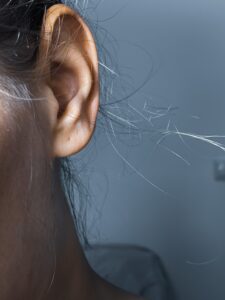
    side of head showing ear

    How can I know if I have earwax?

    When earwax builds up, it can produce a variety of symptoms, including:

    Ear pain and the sensation of having a “clogged ear.”

    Hearing loss occurs when earwax prevents sound waves from efficiently reaching the eardrum.

    Internal sounds such as chewing, breathing, heartbeat, and even one’s speech are no longer able to leave the ear and are therefore perceived considerably louder in the head.

    Tinnitus is a ringing/whistling/humming sound only you can hear.

    Vertigo is vertigo caused by increased air pressure produced by earwax buildup.

    Whistling hearing aid: noises enhanced by the hearing aid are reflected into the ear due to earwax buildup.

    Itching/irritation: When you move your jaw, infiltrating earwax, particularly dry earwax, scrapes on the side of the ear canal.

    How can I get rid of earwax in my ears?

    There are numerous methods for safely and gently removing earwax and cleaning the ear, depending on the consistency of the earwax. Symptoms are often eased shortly after the earwax is removed.

    A competent specialist should remove earwax from deep within the ear canal. Never putting anything in your ear canal will assist.

    Micro-suction

    Earwax is removed with a low-pressure suction machine and a fine, sterile probe using video otoscopy equipment.

    Irrigation of the ears

    This approach, which replaces the traditional ear syringing method, employs an irrigation device to guide water into the ear rather than squirting it directly. This allows the water to drain away the earwax safely.

    Extrusion by hand

    The audiologist removes the earwax with micro-instruments utilising state-of-the-art video otoscopy technology that directly visualises the earwax.

    If you detect changes in your hearing, you should have it checked by a skilled audiologist to see if the problem is caused by earwax or other ear ailments.

    Brought To You By – Ear Wax Removal Bury st Edmunds.

    The post The Connection Between Earwax And Food appeared first on https://gqcentral.co.uk